ALUMNI
More than Theory: Lived Experience, Vulnerability, and the Journey from Sanata Dharma to Monash
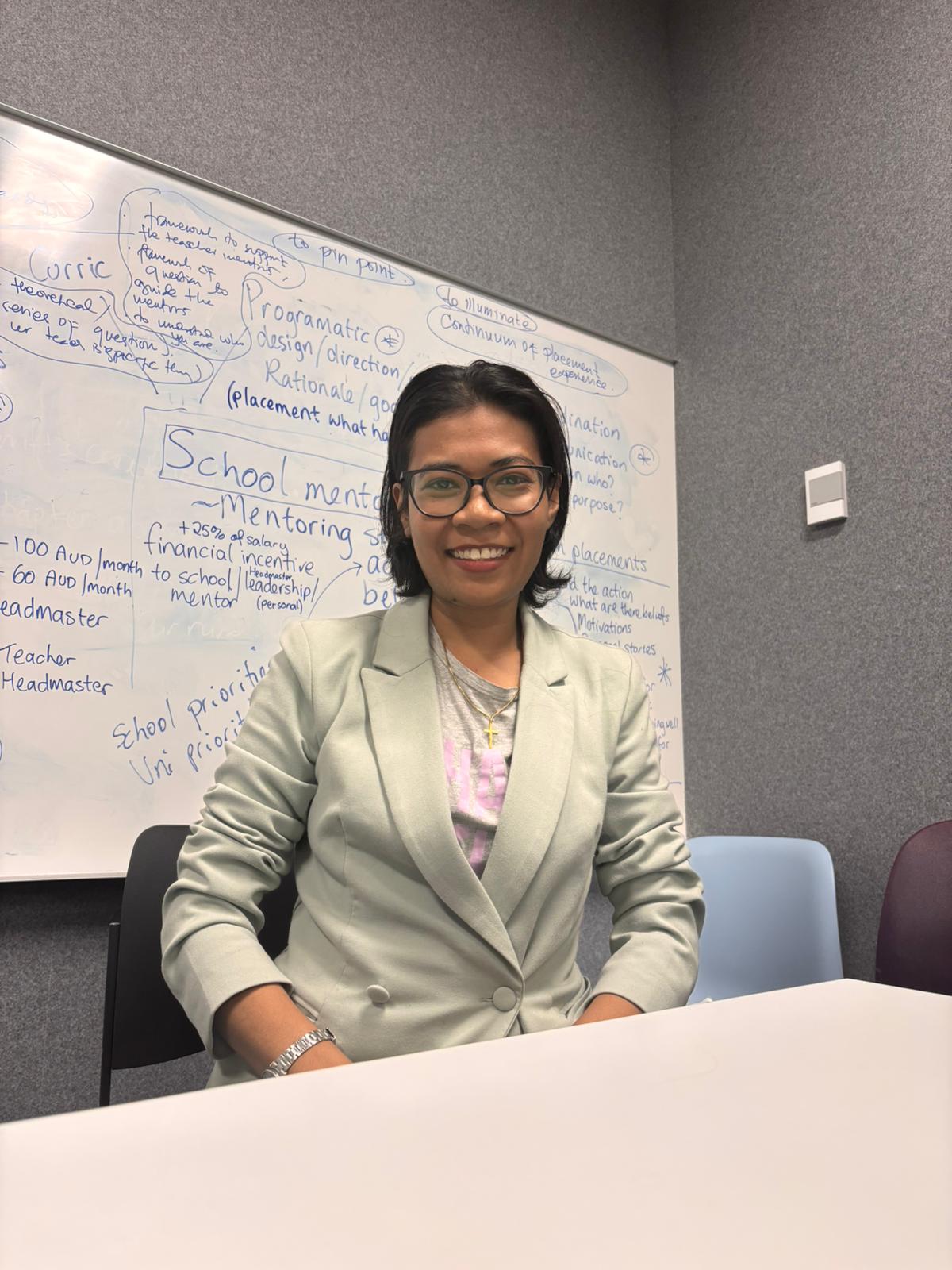
Erlyn Lasar embarked on her academic journey in the English Education Study Program (PBI) at Sanata Dharma University in 2012, graduating in 2016. Directly after completing her undergraduate degree, she continued her studies in the English Education Master Program (MPBI) at Sanata Dharma, from 2016 to 2018. These years at Sanata Dharma laid a significant foundation that would later prove invaluable as she pursued her doctorate.
Initially, when Erlyn first entered the S1 PBI program, her goal was "in the framework of not becoming a teacher". However, this perspective began to shift around her fifth semester. This period was marked by her encounter with two lecturers, i.e. Pak Markus Budiraharjo and Prof. Concilianus Laos Mbato, through their courses that she took. Joining their courses, Erlyn reflected, was a crucial moment, "right at that moment, I decided I would become a teacher".
She was so deeply impressed the way these senior lectures taught, and deep down in her heart, she dreamed of emulating the two exemplars. Recalling the crucial turning point in her life, she admitted to have undergone "critical incidents" that convinced her to actively construct her own identity as a teacher candidate, centering on her commitment to engage in lifelong learning. The MPBI program at Sanata Dharma proved particularly influential. Erlyn highlights the Teacher Identity Construction (TIC) course, team-taught by Pak Kuswandono and Prof Cons, as a very significant experience. This course directly addressed the concept that would become the focus of her future research.
Overall, the pedagogical approaches and paradigms experienced in MPBI further built upon this foundation. Beyond specific course content, Erlyn deeply values the learning environment fostered during her master's studies. She describes the lecturers in the MPBI program as being very "transparent but also vulnerable at certain moments". This modeling positioned the lecturers as learners themselves, which was deeply internalized by Erlyn and later influenced her own teaching. She recalled moments of sharing and 'makrab' where there was no "personal or professional distance between students and lecturers".
The six lecturers in the first MPBI cohort, including Prof Cons, Pak Markus, Bu Retno, Pak Barli, Pak Kus, and Pak Ouda, served as "continuous role models" as true lifelong learners. A specific method from her MPBI experience that left a lasting impression was Pak Markus's impromptu and uninterrupted writing session. Erlyn found this method provided a space for her to be "vulnerable as a student" and consistently engage in self-reflection. She realized that much of her learning approach was shaped by these methods and experiences at MPBI, both consciously or unconsciously..png)
This approach to learning, deeply rooted in "lived experience that is not only at the theoretical level but also lived out", became fundamental for her personal growth and identity. These collective experiences from both her S1 and especially her MPBI program at Sanata Dharma served as a robust foundation for her doctoral studies at Monash University. Erlyn feels that the MPBI program specifically provided her initial motivation to pursue higher education, guided her thinking toward her research direction, and provided ideas of how she would implement ideas. The concepts and framework acquired were very relevant to her current work with her doctoral studies. She kept emphasizing that how grateful she had been with her bachelors and master experiences at Sanata Dharma Univeristy.
The doctoral program at Monash is full research with no coursework, requiring significant independence. It also demands critical thinking, risk-taking strategies, and the capacity to acknowledge one's vulnerabilities. Erlyn feels that the emphasis on self-reflexivity and the example of lecturers embracing vulnerability at MPBI were crucial in helping her navigate these demands. Her personal experiences and skills in navigating different situations, developed during her prior studies, also help her make the most of the supportive atmosphere at Monash despite the inherent difficulties of doctoral research.
In particular, she found that "my ability to carry myself also turned out to be useful" at Monash. Even facing challenges, such as her admitted struggle with academic writing, she remains resilient and persistent in her academic pursuit. She recalled having co-publish a book with Pak Markus when she was in undergraduate in 2016. That publication, in particular, helped me shape her own identity as a future researcher. Prior to her undergraduate years, she had published a novel. She viewed herself as a writer of stories. "Academic writing was not my strength back then," she recalled.
She recalled a moment in her S1 critical writing class with Pak Markus where her initial writing was so poor that her lecturer didn't understand it, leading her to cry. However, this moment became a "turning point" and she now reflects on how far she has come from that starting point. She finds the supportive community at Monash, where she feels comfortable asking questions, reminiscent of her positive experiences at PBI and MPBI. She feels that the atmosphere at the HDR (Higher Degree Research) forum at Monash "is not much different from what is at Sanata Dharma", where she never felt excluded or that her questions were too silly.
The concept of life being paradoxical, learned from Pak Markus, even aids her in navigating community dynamics among Indonesian students at Monash. Ultimately, Erlyn feels that her educational journey at Sanata Dharma, particularly the depth of experience in the MPBI program concerning teacher identity construction, the modeling of lecturers as learners, the emphasis on self-reflexivity, and the cultivation of a supportive community, provided her with a strong, relevant, and resilient foundation for the intellectual and personal challenges of her doctoral studies.
Her current doctoral research topic directly builds upon the concepts she engaged with deeply during her time at Sanata Dharma. She feels that her prior experiences are like a "social emotional saving that was built before that can be recalled and then become a stepping stone to jump".
eMBi