NEWS
Development of the Master of English Education Curriculum based on new Government Regulations and input from the CALOHEA Project
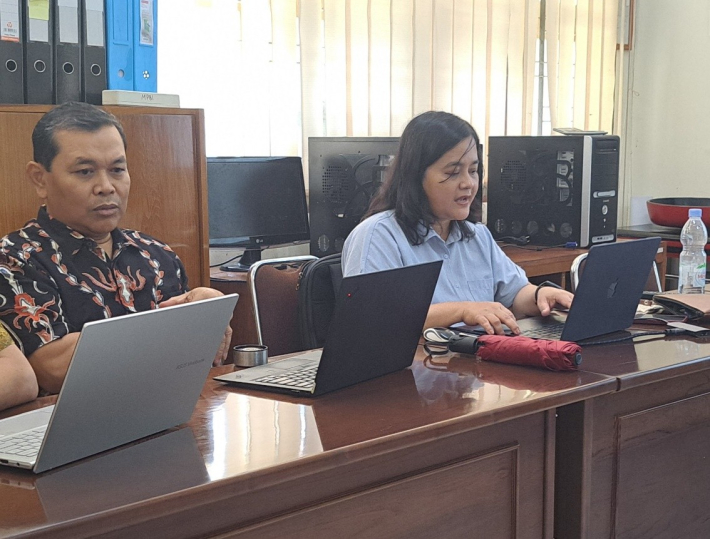
Regulation of the Minister of Education, Culture, Research and Technology (Permendikbudristek) Number 53 of 2023 concerning Quality Assurance in Higher Education regulates the number of credits that must be completed by Master's students. In this way, MPBI USD also carries out further curriculum development. In the previous curriculum, students were required to complete a minimum of 38 credits. According to the latest regulations, master's students must complete between 54 and 72 credits. Changes in the credit load especially occur in theses and research courses. This change is expected to optimize the student learning process by adding a significant additional learning load.
Apart from considering the Regulation of the Minister of Education, Culture, Research and Technology (Permendikbudristek) Number 53 of 2023 concerning Quality Assurance in Higher Education, this curriculum development also applies input from the results of the CALOHEA research project which has been running for the last three years. The three MPBI lecturers involved in this research were FX. Ouda Teda Ena, Paulus Kuswandono, and Christina Kristiyani. The contribution of ideas from the CALOHEA Project is especially regarding student learning load and implementing authentic assessment.
The implementation of calculating student learning load is carried out using various adequate instruments. Surveys and Questionnaires were Developed. It adopted standardized surveys to gather data from students about the time spent on various academic activities that had been used in the CALOHEA Project. Time Diaries/Logs were also used by asking students to maintain a diary or log of their daily academic activities. Focus Groups and Interviews were conducted to gather qualitative data. Learning Management System (LMS) Analytics was conducted to track time spent on online activities.
The student learning load that is used as input for the MPBI curriculum includes Classroom Time (scheduled lecture hours, seminars, and labs); Self-Study Time (time spent on reading, homework, assignments, and projects); and Assessment Preparation (Time spent preparing for exams, quizzes, and other assessments).
Apart from that, the result of MPBI's participation in the CALOHEA Project is the increasingly stable implementation of authentic assessment. Authentic assessment is a form of evaluation designed to assess students' abilities in 'real-world' contexts. It emphasizes the practical application of knowledge and skills, rather than relying solely on traditional testing methods. It is a performance-based assessment. Students demonstrate their understanding through active tasks rather than passive responses (e.g., projects, presentations, experiments). It encourages critical thinking, problem-solving, and the application of knowledge. It focuses on the student's process and product, often allowing for individual choice and creativity.
This curriculum revision is also coordinated with other Master's programs at USD. It is hoped that the curriculum that has been reorganized will be implemented in the next new academic year.

- Juthatip Mingkun and Co-Researchers Explore Cross-Cultural Teaching Experiences in Thailand
- Caku and Co-Researchers Examine Code-Switching in Viewer Comments on Indonesian Educational YouTube Channel
- MPBI Students, Gabriela and Friends Publish Research Article in Journal of English Educational Study (JEES)
- MPBI Shares Ideas on SDG 4 and Educational Transformation at International Forum
- MPBI Opens 2026 Scholarship Programme for Outstanding Sanata Dharma Alumni
- Becoming a Living Witness: Master’s Program of English Education, Sanata Dharma University Professor Empowers Lay Ministers in St. Maria Assumpta, Parish, Gamping Through Public Speaking Workshop
- Exploring the Responsible Use of Generative AI in Education: MPBI Hosts National Webinar on Ethics, Practices, and Collaboration
- English Mastery and Mindful Pedagogy: Sleman Educators Navigate Digital Friction at SMAN 2 Ngaglik
- Generative AI for Education: Ethics, Practices, and Collaboration
- Inspiring Story: Teacher Yooyee’s Transformative Learning Journey in Yogyakarta